
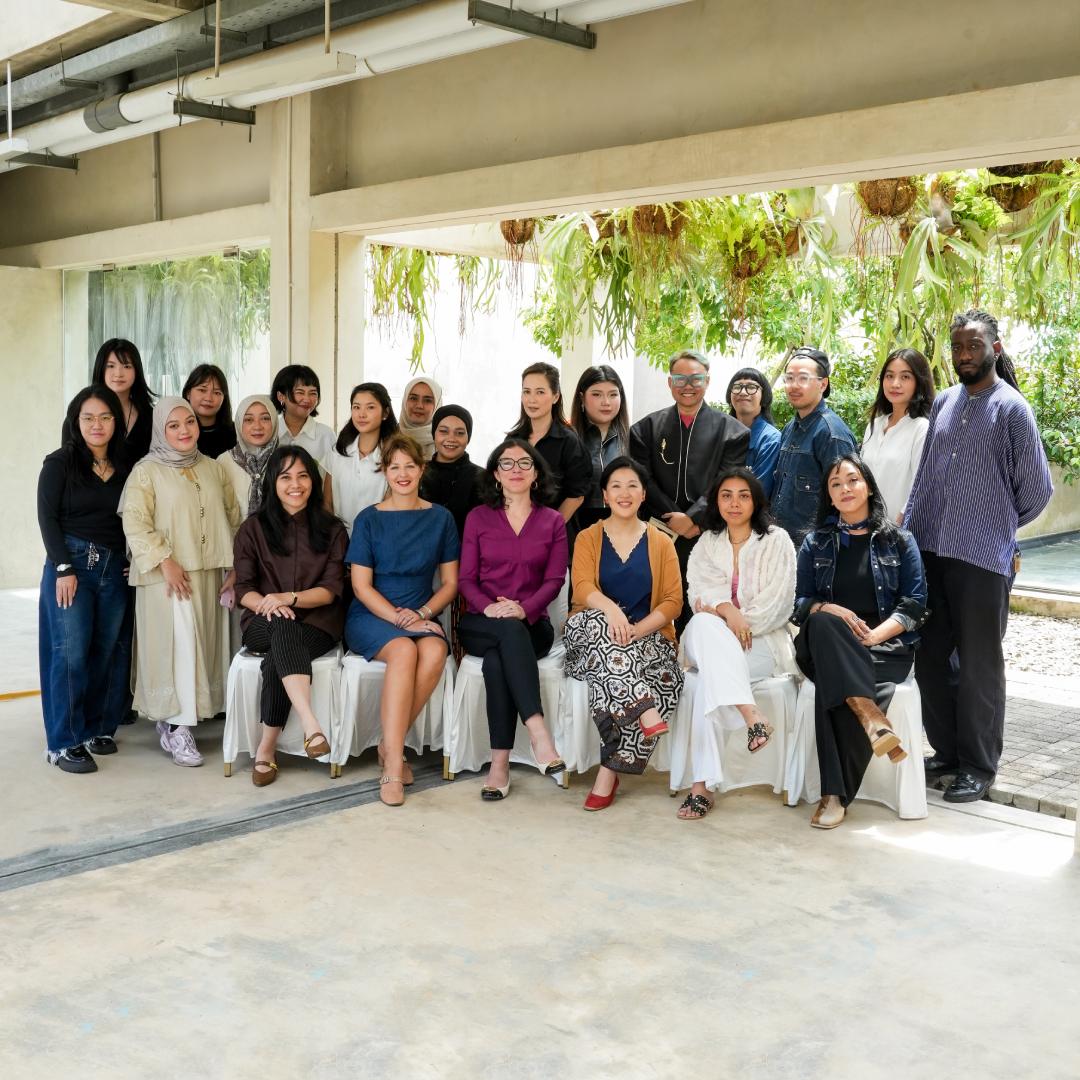
Photo: Thresia Mareta, co-initiator of PINTU Incubator Program and founder of LAKON Indonesia, and Carol Meyer, Cultural Attache at the French Embassy and representative of Institut Francais d'Indonesie, alongside incubees, French and Indonesian Resident, and accelerator participants at the opening orientation of PINTU Incubator Program 2026 at Teras LAKON
18 April 2026
The Door Is Open: PINTU Incubator Program Announces Its 2026 Incubees of Designers and Brands
Highlight
The fashion industry has never had a shortage of talent. What it has consistently failed to provide is infrastructure, the unglamorous, load-bearing framework that determines whether a creative vision becomes a lasting brand or simply a promising moment that runs out of road. That gap is precisely what the PINTU Incubator Program was built to close.
On April 6, 2026, ten designers and brands were announced as the program's first 2026 batch, not with ceremony, but in the way most characteristic of PINTU: directly, and with immediate work to do.
A Curation Built on Readiness, Not Just Talent
The program is not a showcase, not a competition, and not a shortcut to visibility. It is a long-term investment, a structured curriculum spanning export strategy, financial management, brand identity, and international market entry, offered to brands that have moved past the initial idea but do not yet have the infrastructure to grow seriously.
This year, ten names have joined the 2026 batch, but this is only the beginning of a rigorous, multi-stage curation process. The selection unfolds across three distinct phases. These ten names have passed the first curation and were announced on 6 April, 2026. A second curation will take place on 22 May 2026, with results announced the following day on 23 May 2026. The process culminates in a third and final curation on 12 June 2026, with the final announcement on 13 June 2026.
Each of the ten brings a distinct design language, specific cultural rootedness, and a roadmap that extends well beyond the domestic market. The curation is not a judgment of worth, every participant has already earned their place. It is a calibration of readiness.
Behind the program is a curatorial team whose expertise spans the full breadth of what independent fashion brands actually need to grow. Thresia Mareta, co-initiator of PINTU Incubator Program and founder of LAKON Indonesia. Susan Budihardjo, senior designer and founder of Susan Budihardjo Fashion Forward Institute. Lydia Kartawidjaja, Merchandising Director of Star Department Store. Andi Yuktipada contributes expertise in business planning and modeling. Rounding out the team is Carol Meyer, Cultural Attache at the French Embassy and representative of Institut Francais d'Indonesie.
The 2026 Incubees
The diversity of this incubees is not simply a matter of numbers. Within it: a genderless label that treats recycling as design methodology, a craft house transforming ancestral motifs into collectible handmade bags and a fine-art label constructing corsets from borax crystal. They arrive from different backgrounds, an architect who pivoted to fashion, a leather craftsman who has been at his bench since 1997 and a natural-dye community in a village far from any fashion capital. What unites them is not aesthetic, but ambition: to build something that lasts.
The Brands
Toja House

Photo: Toja House, PINTU 2026 Incubee
A Yogyakarta-based cultural craft brand that transforms Indonesia's ancestral textile motifs, Kawung, Mamuli, Palawa weaving, Buna, and Noken, into contemporary handmade bags by women artisans, treating craft not as nostalgia but as living heritage with global relevance.
Ulur Wiji

Photo: Ulur Wiji, PINTU 2026 Incubee
A Mojokerto-based eco-fashion brand producing modest ready-to-wear batik using exclusively plant-based natural dyes and certified natural fibers, repositioning batik as modern and timeless while empowering rural youth artisans under the motto "Dari Desa Bisa Berdaya".
Sausan Official

Photo: Sausan Official, PINTU 2026 Incubee
A Bandung-based modest fashion brand producing premium linen womenswear in curated seasonal collections, blending cottagecore-rustic aesthetics with modest silhouettes for professional Muslim women who value quality and understated elegance.
Tegep Boots

Photo: Tegep Boots, PINTU 2026 Incubee
A Bandung-based pioneering handmade leather brand established in 1997, crafting bespoke boots and premium leather goods entirely by hand using centuries-old techniques, while carrying institutional weight as a keeper of Indonesia's artisanal leather legacy.
Saul Studio

Photo: Saul Studio, PINTU 2026 Incubee
A South Jakarta-based identity fashion brand founded by an architect-turned-designer, translating structural thinking and geometric precision into feminine, modern silhouettes through limited releases and strong storytelling under an affordable-premium positioning.
The Designers
Andrean NR

Photo: Andrean Nuur Ramadhan (ANDREAN NR), PINTU 2026 Incubee
A Spark Fashion Academy-trained designer based in Yogyakarta, Andrean builds genderless ready-to-wear that embeds recycling as a core design methodology while bridging traditional Indonesian craft sensibility with contemporary, inclusive aesthetics.
I Kadek Krisna Dwipayana (KRINS Studios)

Photo: I Kadek Krisna Dwipayana (KRINS STUDIO), PINTU 2026 Incubee
An Institut Seni Indonesia Bali graduate, Krisna founded KRINS Studios to reposition Tenun Endek and Balinese craft heritage as a living global design language through natural dyes, zero-waste patchwork, and modern silhouettes.
Aldrie

Photo: Aldri Indrayana (ALDRIE), PINTU 2026 Incubee
Trained at The Fashion Institute Sydney and Central Saint Martins, Aldri channels the anxieties of the sandwich generation and Indonesian folklore into minimalist, avant-garde wearables that integrate Batik and Tenun with a recognized commitment to upcycling.
Berlianti Alamanda Prameswari Gondo Kusumo (Esvari)

Photo: Berlianti Alamanda Prameswari Gondo Kusumo (ESVARI), PINTU 2026 Incubee
An ESMOD Jakarta graduate, Berlianti pushes garment-making into wearable fine art territory through unconventional materials like borax crystal and resin, crafting sculptural high-fashion pieces built on narratives of strength and elevated femininity.
Daciadhia Phoebehana (DACIA)

Photo: Daciadhia Phoebehana (DACIA), PINTU 2026 Incubee
A Binus Northumbria School of Design graduate, Daciadhia builds boundary-free, unisex ready-to-wear and bespoke collections where cutting-edge silhouettes meet timeless elegance, grounded in a full-supply-chain commitment to sustainability.
A Deliberate Beginning, Shaped by Structure and Vision
On Monday, April 6, 2026 orientation was opened at Teras LAKON by Thresia Mareta, founder of LAKON Indonesia and co-initiator of PINTU Incubator Program, and Carol Mayer, Cultural Attaché at the French Embassy in Indonesia and representative of Institut Français d'Indonésie, not with ceremonial applause, but in the way more characteristic of Pintu: directly to the point.

Photo: Thresia Mareta, co-initiator of PINTU and founder of LAKON Indonesia, Gave a Welcoming Speech at the opening orientation of PINTU Incubator Program 2026 at Teras LAKON
The following day, the first online sessions were already running. Yosua Yosafat and Iman Nurakhmad Fajar led a class on export and import, not as a theoretical introduction, but as a working map for brands that have already written 'international expansion' into their three-year plans. Understanding regulatory compliance, cross-border logistics, and foreign market positioning is not supplementary knowledge for these brands. It is the infrastructure that will determine whether their creative ambitions can actually move.
Ari Handojo then delivered a session on finance and accounting, perhaps the topic least often spoken about honestly in independent designer circles and the one most frequently responsible for a talented brand stopping before it should have. Building a brand that stays solvent as it scales is not a compromise on creativity. It is precisely what makes continued creative work possible.
Indonesian fashion's growing international credibility is not accidental. It has been built, incrementally, by designers and brands willing to do the foundational work that visibility alone cannot substitute.
The PINTU Incubator 2026 batch represents that work in progress , ten distinct creative visions, grounded in cultural specificity, preparing to enter a global conversation on terms they have built themselves.
The door is open. The work has already begun.
To revisit the 2025 batch and their journey toward the global stage, read the full story here.